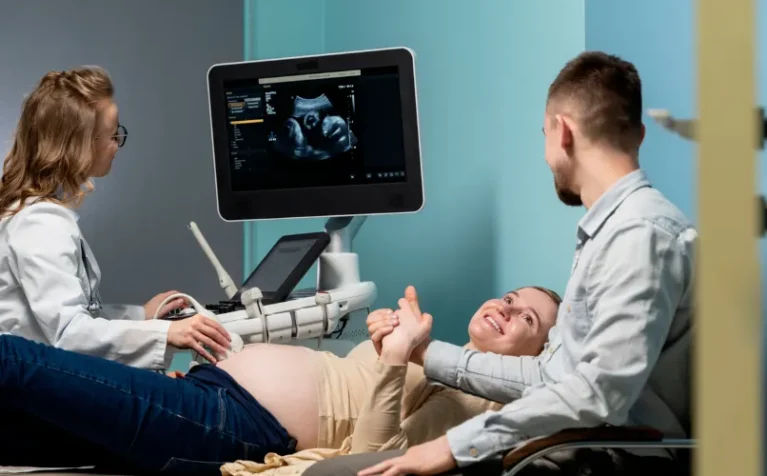
If you have any questions about what you need to do to prepare for your ultrasound appointment, please contact us as early as possible.
You can MESSAGE us
Any time on our Contact page.
You can READ frequently
asked questions on our FAQ page.
This article explains how a dating scan goes beyond confirming your due date, covering early pregnancy safety checks, heartbeat assessment, growth measurements, screening preparation, and the important behind-the-scenes evaluations performed by experienced sonographers.
Many expecting parents look forward to the first ultrasound with nervous excitement. The moment when you see that tiny flicker on the screen becomes even more special with the long-awaited confirmation of a due date. And a dating scan brings that moment to you. Typically performed between 6–12 weeks, the dating scan is the first milestone of your pregnancy journey, one of the first pages of your baby’s life. It lays the foundation for your entire obstetric record and guides future care decisions. Many expecting parents wonder why they’re asked to arrive with a full bladder. It isn’t just a routine instruction. It helps our sonographers see deeper into the pelvic area with greater clarity using high-frequency sound waves. In this blog, we’ll explore what dating scans are, why they’re important, and what they check.
But why is a dating scan done so early on in the pregnancy? The first trimester is when your baby’s growth follows a predictable timeline. So, when you do a dating scan between 6-12 weeks, we can measure the Crown-Rump Length (CRL) and determine your baby’s gestational age with remarkable accuracy. Australian clinical guidelines suggest early scans because they offer a more reliable timeline than relying solely on the last menstrual period. Having an accurate date from the start helps your GP to track growth milestones, schedule screening tests at exactly the right time, and avoid unnecessary interventions later in pregnancy. It makes every future scan and check-up clearer and more meaningful.
There is nothing quite like the feeling of seeing your baby’s heartbeat for the very first time. As a mother, you’ll naturally focus on that first glimpse (not the sound, not yet) of your little one. But our sonographers focus on measuring growth patterns to ensure they align with gestational age. They assess the baby’s early movement patterns, strength, and the regularity of its heartbeat. By looking beyond the image itself, we help ensure your pregnancy begins with the strongest possible clinical foundation.
At this stage, parents often ask about the baby’s gender, but a dating scan is not designed for gender determination. While the curiosity is natural, these early weeks are dedicated entirely to physiological health.
Did you know that in some rare cases, a fertilised egg may get implanted somewhere else instead of the uterus? This is called an ectopic pregnancy. Your uterus (womb) is the only place designed to expand and nourish a growing baby. So, if your pregnancy is located anywhere else, it is a risky situation that needs to be identified and treated early. That’s why the first thing our sonographers check in the dating scan is a ‘gestational sac’ sitting squarely in the middle of the uterine cavity, which confirms the location of the pregnancy.
Beyond the baby, this scan is also used to check on the mother’s health. Our sonographers will assess your ovaries and uterus for any cysts or fibroids. These are common and usually nothing to worry about, but identifying them early gives your doctor the time to monitor them throughout your 40-week journey.
Expectant parents are naturally captivated by those first tiny movements on the screen, but for sonographers, a dating scan is a very critical part of pregnancy ultrasound scans. Our sonographers do more than just date the pregnancy; they look for subtle structural markers that indicate normal development. They assess important details, such as observing early placental position and reviewing the overall health of the uterus and ovaries. And if you’re having twins, this is where the sonographer carefully determines chorionicity (whether babies share a placenta), as this vital detail can help your doctor to plan safe, well-monitored care throughout pregnancy.
A dating scan doesn’t just reflect the present; it prepares you for the future. The measurements taken today act as a bridge to your next steps, such as an NT scan or Nuchal Translucency screening (between 11–13 weeks). In Victoria’s health system, these early measurements are essential for calculating screening results with total confidence, so you get the clarity to make informed decisions for your family.
Ultimately, a dating scan is far more than a photo opportunity; it is a sophisticated medical deep-dive wrapped in a moment of joy. At Insight Diagnostic Imaging, we believe you shouldn’t have to choose between clinical excellence and a warm, supportive environment.
Every ‘quiet check’ we perform is designed to give you and your healthcare providers the most accurate start possible. If you’re beginning your pregnancy journey in the Springvale or Dandenong area, we invite you to experience a scan that values the science of ultrasound as much as the soul of the experience.

No — around 7 weeks is often an ideal time for an early dating scan, especially if dates are uncertain or there are clinical reasons for reassurance. At this stage, measurements like Crown-Rump Length can be very accurate, and key early structures can usually be assessed clearly.
A dating scan is not designed to determine gender. The focus at this stage is to confirm gestational age, pregnancy location, and early development. Gender is typically assessed later in pregnancy, when anatomy is more developed and visible on ultrasound.
In many cases, yes, a heartbeat can be seen (but not heard) at this stage. A fetal heartbeat can often be detected from around 6–7 weeks, depending on individual development and scan timing. If it’s not clearly visible yet, your healthcare provider may recommend a follow-up scan for confirmation.
Comfortable, two-piece clothing is usually best, as it allows easy access to the abdomen while keeping you comfortable during the scan. You may also be asked to arrive with a full bladder, so wearing something practical can make the experience easier.
Most dating scans take around 15–30 minutes, depending on visibility, fetal position, and whether additional checks are needed. Our goal is to balance thorough assessment with a comfortable, reassuring experience for every patient.
A full bladder helps lift the uterus slightly and creates a clearer pathway for sound waves, allowing the sonographer to capture sharper images in early pregnancy. This improves visibility, especially during abdominal scans in the first trimester.
One of the key measurements is the Crown-Rump Length (CRL), which helps determine gestational age with high accuracy. The sonographer may also assess the gestational sac, yolk sac, and early structures to ensure development aligns with expected timelines.
Yes, a dating scan can often identify multiple pregnancies. If twins are present, the sonographer will also assess chorionicity — whether babies share a placenta — which is important for planning safe monitoring throughout pregnancy.